GOD AS MOTHER : NAMES 61 TO 70

LALITHA SAHASRANAM   ललिता सहस्रनाम      MAI SAHASRANAM माई सहस्रनाम 

61) Sudhaasaagara-madhyasthaa सुधासागरमध्यस्था – Residing in the centre of the ocean of nectar, with which the city is surrounded.ललिता सहस्रनाम स्तोत्र, नाम क्रमांक 61

Some of the principal places of Her residence are enumerated as:-

(1) Mountain, (2) City, (3) Happy home, (4) Lotus forest (5)Kadamba groves and (6) Ocean.

Mountain is golden and miraculously herbed. City is full of civilization. Home is seat of sacrificing, fraternal and parental love and sheltering place for guests, hungry, distressed, etc. Forests represent renunciation. Groves represent sportivity. Ocean represents immortality.

Thus She is prominently present wherever there is an over poweringness of Royalty, Civility, Hospitality, Sportivity and immortality, affording a happy and wonderful combination of even contrasts.

62) Kaamaakshi कामाक्षी –Lovely eyed. She to whom Her devotees are as dear as Her own eyes.ललिता सहस्रनाम स्तोत्र, नाम क्रमांक 62 

63) Kaamadaayini कामदायिनी –The fulfiller of desires. ललिता सहस्रनाम स्तोत्र, नाम क्रमांक 63

64) Devarshigana sanghaata stuyamaanaatma vaibhavaa 

देवर्षिगणसंघातस्तूयमानात्मवैभवा – Her power is praised by the assemblies of multitudes of Devaas and Rishis.ललिता सहस्रनाम स्तोत्र, नाम क्रमांक 64

Mother is “lovely-eyed” and “fulfiller of all desires.” Mother is a wonderful player in both fields of opposites, so that She is equally praised by Devaas full of desires and greatness and abundance of all enjoyments, as also by Rishis the masters of Siddhis, divine knowledge, meditation and renunciation, etc.

65) Bhandaasura-vadhodyukta-shakti-senaa-samanvitaa  

भण्डासुरवधोद्युक्तशक्तिसेनासमन्विता – She is endowed with an army of Shaktis (powers) for the sake of slaying the sinful-suggesting and life-sucking in-dweller.ललिता सहस्रनाम स्तोत्र, नाम क्रमांक  65 

There is a belief in many religions that there is a Satan or a devil,who drives away one towards sinfulness. Here the idea is that there is an in-dweller within every being, something like the personification of the lower mind, who is an unavoidable being, being co-existent with the embodied and imprisoned soul, afflicted with ignorance, impermanency, limitedness, pain, sorrow, fear, etc.

The best way of breaking this In-dweller’s power is prostration to Mother’s Lotus Feet, as by falling flat before Mother’s Lotus Feet, the in-dweller is within our grip, being pressed between the ground and our heavy body. He can be emaciated and annihilated in course of time by the all-evil-consuming rays rushing from the Lotus Feet, the fingers and the nails which while coursing through our head and heart up to the toe and returning to Mother’s Feet, take away a large portion of our worldly attachment and consciousness.

Asura असुर is made of Asu असु, meaning life and ra र meaning to take awayAsura असुर therefore means he who takes away life. Mythologically Bhandaasura was a demon born from the ashes of the God of love after he was burnt by Shiva. Philosophically the outlook about good and evil should be widened on knowing that evil is only offspring of love itself, but when misplaced.“Bhanda” भण्ड means beautiful to look and hellish to deal with, wrathful and shameless, apologising and repeating the same sins and harassments again & again.”Bhandaasura”  

भण्डासुर may also mean a fettered soul and to destroy him means to transmute a bound soul to be a free soul.

As there are many further descriptive names, it is better to go side by side , with different meanings comprising concrete and abstract conceptions , and literal and philosophical interpretations. The reader of the book like this is expected to do much of the gap-filling, sorting and similar work, himself. There must be an ample field for him to exercise  his own faculties, to serve himself and Mother. 

The Mother’s army consists of Ganesha and Bhairava and ShaktisGanesha means determination after discrimination, and Bhairava means strong and perseverant, whole-hearted, nothing-sparring effort. Shaktis means powers which are best gained and awakened by Mother’s meditation, as Meditation has creative power.

66) Sampatkari-samaarudha-sindhura-vraja-sevitaa 

संपत्करीसमारूढसिंधूरव्रजसेविता – Attended by herds of elephants conducted by Sampatkari.ललिता सहस्रनाम स्तोत्र, नाम क्रमांक 66

To these elements of discrimination, determination, and efforts, is added the cheerfulness which is the fulness of the joyous state of mind, with patience.

Elephants are known for wisdom and their quite and cheerful disposition. In one word they are of Saatvik, i.e., equipoised and discriminative nature.Elephant-goad is previously stated to represent control or knowledge. So Sampatkari is the knowledge-energy of the three energies.

67) Ashvaarudha-adhishtita-ashva-koti-koti-bhiraavritaa

 अश्वारूढाधिष्ठिताश्वकोटिकोटिभिरावृता Surrounded by many crores of horses conducted by Ashvaarudha.ललिता सहस्रनाम स्तोत्र, नाम क्रमांक 67

The power of Ashvaarudha sprang from the noose of Lalitaa and ran in front of Mother with a great speed, riding a horse called Aparaajitaa अपराजिता ( The invincible ), and crores of swift horses followed Her.The senses are called horses. Arudhaa अरूढा means rider (of horses), the controller of the senses, i.e., mind.

What is meant by Ashvaarudha riding, followed by crores of horses, is that She directs and drives endless sense-impressions in millions of minds simultaneously. Thus Ashvaarudhaa is full of Raajasik,राजसिक i.e., active nature. The noose represents desire, and Ashvaarudhaa may be taken to mean energy of desire.

Viewing Mother as in battle field She has in Her army:- first, elephants with Sampatkari संपतकरी , then horses with Ashvaarudhaa अश्वारूढा, next Dandini दण्डिनी, then Mantrini मन्त्रिणी and then She Herself. Dandini दण्डिनी, Mantrini मन्त्रिणी and Herself are seated each in a chariot.

Dandini rides forth with a rod in her hand and is a power of action. She proclaims the advent of Mother striking fear and establishes the consciousness about the final supremacy of the powers of Mother that follows. Mantrini who next follows is the intimate minister of Mother for discussion, decision and propagation of the simplest welfare remedy of repeating Her names with sacred Mantras Praise Hymns, etc.

Viewed from the point of view of the inner life, while conquering the inner foes , it becomes apparent that the first thing is that the knowledge of our imperfection & bondage.(Sampatkari). The second thing is the strong desire to do everything to be, be liberated. (Ashvaarudhaa).The third thing is breaking all obstructions with the rod. Say, by making chitta-shuddhi or attaining purity of mind by hard struggle, by penance, by becoming enemy of oneself, and by undergoing rigid observances, etc.(Dandini). The fourth thing is Grace which is the result of Mantra repetition, devotion, praising Mother,etc. (Mantrini). The fifth and last thing is the acceptance by mother Herself, on perfecting what still remains as imperfection.

To understand and appreciate Mother’s names one great truth should be constantly borne in mind, viz., the underlying idea of the intense spirit during the repetition of all descriptions is that Mother makes Her devotee to be what She is described as, and that Her devotee becomes Mother like by either Her special making or by natural psychic law of ” We become what we meditate upon,” or by the combination of both Grace and unifying meditation.

Thus when we describe Mother as victorious over worst enemies, apparently, there is no propriety of saying so when Mother is all in all, but the spirit behind the idea of repeating the name, and of praising Her with these words is that the devotee becomes victorious over his worst enemies. 

68) Chakraraaja-rathaarudha-sarvaayudha-parishkritaa 

 चक्रराजरथारूढसर्वायुधपरिष्कृता –  Seated in the chariot named Chakraraaja, She is armed with all the weapons. ललिता सहस्रनाम स्तोत्र, नाम क्रमांक 68

The king of chariots, Chakraraaja, belongs to the great Queen Mother and it carries Ananda flag, the flag of Bliss.

It should be noted Mother alone has weapons and she has all weapons. The other two can help, but not finally and fully.

“She has all weapons.” This means that however wicked or weak you may be, that can be set right in no time by Mother’s Grace. Bliss which represents the flag is secured for them that are under Her banner.

For a very mediocre devotee who prays for immediate relief or gain, Chakra means all different vicissitudes of life, the various ups and downs. She is the Raaj राज (Master) of them. TheDisposer of them. She is always ready for earliest flight to the devotee being Rathaarudha i.e., mounted in chariot, with all weapons, i.e., remedies to secure relief to the devotee against all kinds of enemies or obstructions , as of personal imperfections or worldly in-congenialities, etc.

69) Geyachakra-rathaarudha-mantrini-pari-sevitaa 

गेयचक्ररथारूमन्त्रिणीपरिसेविता – She is attended by Mantrini who rides the chariot Geyachakra. ललिता सहस्रनाम स्तोत्र, नाम क्रमांक 69

By Geya the simplest meaning may be taken to be “praiseworthy”. Geya means worthy of singing or carrying singing as in modern radio-furnished motors. Geya chariot may be taken to be chariot ” connected with praise ,” i.e., sympathetic with the pedestrians on the spiritual path of praising, singing psalms, etc., i.e., devotion to Mother.

70) Kirichakrarathaarudha-dandanaathaa-puraskritaa 

किरिचक्ररथारूढदण्डनाथापुरस्कृता – She is preceded by Danadanaatha, who rides Her chariot Kirichakra. ललिता सहस्रनाम स्तोत्र, नाम क्रमांक 70

Kiri means boar.The chariot is drawn by boars. Kirichakra-mounting is riding rough-shod.

Taking the case of very mediocre devotee, to start with, Dandanaatha दण्डनाथ same as Dandini दण्डिनी, helps him by giving him strength to override rough conditions and sometimes also by saving him from consequences of others riding rough-shod over him. Next, Mantrini मन्त्रिणी saves him from the evils of worldliness and of temporary happy living, by constantly reminding him of the Mother’s lotus Feet, and of the supreme truth, that whatever good has fallen to his lot is due to Her Grace


GOD AS MOTHER : NAMES 51 TO 60

LALITHA SAHASRANAM  ललिता सहस्रनाम           MAI SAHASRANAMA माई सहस्रनाम

51) Sarvaabharanbhaasuraa सर्वाभरणभासुरा Adorned with every ornament. ललिता सहस्रनाम स्तोत्र, नाम क्रमांक 51

52) Shiva-kaameshvaraankasthaa शिवकामेश्वरांकास्था – ललितासहस्रनाम स्तोत्र, नाम क्रमांक 52  

Mother says to the devotee,” I have been the worshipped and Mother for innumerable lives to thee. Now let me be the worshipper and the daughter to serve thee after so many endless and indescribable miseries that you have suffered for me.”

She as daughter is the sitter in the lap of Her devotee at this stage.

This idea I got at the worshipping place of my most revered old friend Kaushikarambhai V Mehta.
When I went to him, he offered me with great love the best dish of almonds, sugar-candy etc.I would not eat though he repeatedly asked me to eat. The fact was that I do not eat or drink anything without dedication to Mother and I was too shy. My throat was chocked. In a piteous voice I sang two lines by way of an answer. ” Mother, tell me whether you are  Mother and I am son, or I am an old Father and you are my darling lovely daughter! ” Generally, whenever parents gets best dainties to eat, children’s remembrance stops the morsel going down the throat. It was this experience which made joyful and dancing and I said to myself, I have found the meaning of Shiva-kaameshvaraankasthaa.
That Mother takes a fancy and delight to be the devotee’s daughter is not an inappropriate idea. It is only fools who always prefer to be the worshipped and never the worshippers. 

There was a living instance in Bengal, the Blessed home of Mother Worship and the birth province of  Her Blessed son,Shri Ramakrishna Paramahamsa.

A devotee extremely poor once desired to celebrate Durga Pooja festival and went to fetch his daughter for the purpose from her husband’s house. The husband’s family was extremely rich and the members of the family drove out the devotee stating that he was a fool to expect that his daughter who was the queen of the family, which would be celebrating the festival gloriously with grand dinners, would be rolling half-starving at her father’s house.
The devotee returned and on the road journey wept under a tree at the first half of the journey. At the second half he found his daughter shouting out to him to stop. The daughter stated weeping that after his departure there was an exchange of harsh words and she was turned out to her father. The daughter said,” Father, do not worry. You have been old. My husband has given me immeasurable wealth. We shall live together and I will serve you for your life.” The father was still more miserable. Not only he was spurned but his daughter was turned out. The daughter served him shampooing and with most delicate love actually fondling old father- Durga Poojaa was celebrated with devotion gloriousness and lavish spending, in a manner which surprised the whole province. On the ninth night she sat in the devote’s lap in full ecstasy and asked him,” father , tell me honestly, don’t you repent, having taken this idiosyncrasy of devotion to Mother.” The devotee said,” My darling, you are yet too young to have any idea of my love for Mother.”  Next morning the daughter was missing. 


On inquiry it was learnt that his real daughter had not left her husband’s house.

Mother often desires the fanciful pleasure of being the devotee’s daughter. She feels joy of sitting in his lap.
Reader, I am free with thee as we are soon to part, after a few pages. Weep and weep out of love for Mother, if you are a devotee. If you are a heartless learned one , laugh at my folly of wasting my breath in wilderness. Mother has been given Her right status by few devotees. Most of the devotees have understood Her to be stern and awful. Some have exploited Her Grace and Mercy. Very few have loved Mother as Mother.But here the love has been of such an immeasurable intensity that unlike the most universal truth that the Mother fondles the child , the devotee fondles the old Mother, who has been neglected and discarded  by the ungrateful universe.

In love when there is monotony due to the climax of loving in a particular relationship, there is still greater pleasure in inverting the relationship, just as when you have read a book for times without number, you like to read it from last chapter to the first. It is this idea which gives clue to the inversion of the letters of a Mantra.
It is higher than the highest stage of natural love. The natural relationship is one of the schools of the devotees is for woman devotee to consider herself as beloved of Lord Krishna, and some male devotees too as in the Raadhaa-Vallabha school , consider themselves to be Gopis i.e., the beloved of Lord Krishna. On the above lines there is higher than the highest, and it is when the devotee considers God as his beloved.

53) Shivaa शिवा – The beneficial.ललिता सहस्रनाम स्तोत्र, नाम क्रमांक 53

The energy underlying what becomes beneficial through perception, right understanding, true knowledge, practical wisdom, impartial seeing, long fore-sighted thinking, charitable considering, concentrated remembering,healthy conceiving, determined wiling,disinterested loving, legitimate desiring.etc., is a gift and grace of Mother.
The Daanavas and the Devas are on equal relations to Mother; She does good (Shivaa) to all beings.Hence Mother is known as  Shivaa. She is Shivaa because She confers on Her worshippers natural purity, stainless qualities, superiority, supporting power,supremacy and immortality.

She who has assumed the energising aspect connected with one and varied consciousness, who is intellect, without attributes, self-shining, unchangeable, supreme bliss, and the cause of destruction of worldly bondage, is Shivaa.

54) Svaddhina Vallabhaa स्वाधीनवल्लभा – She by whose devotion a lady becomes the master of her husband. ललिता सहस्रनाम स्तोत्र, नाम क्रमांक 54

This is so because she fills his heart with love for her and for her Mother. Such a devotee is full of love for her husband. She regains her husband though lost.

The Mantra ” Jaya Maarkand Maai Jay Maarkand Maai Svaadhina Vallabhe Jaya Maarkand Maai Jaya Maarkand Maai ” [ जय मार्कण्डमाई जय मार्कण्डमाई स्वाधीनवल्लभे जय मार्कण्ड माई जय मार्कण्डमाई ।। ] has wonderfully achieved the desired result. Maai devotees must however, be very careful, not to abuse powers nor to hope any success in illegitimate desires.The Mantra would be successful if the repeaters are faithful and obedient to their husbands. Maai will relieve you speedily of your honest grievance, provided you are humble and righteous.

Another meaning is She by whose devotion a wife regains her husband from overwhelming clouds of misery and distress or from the clutches of some higher powers.

( Saavitri सावित्री, Sachi शची and Sukanyaa सुकन्या are instances in Hindu Mythology.)

55) Sumeru-madhya-shringasthaa सुमेरूमध्यश्रृंगस्था Dwelling on the middle peak on golden Mount Sumeru. ललितासहस्रनाम स्तोत्र, नामक्रमांक 55

56) Shriman-nagara-naayikaa श्रीमन्नगरनायिका – Resident and Ruler of the beautiful city. ललिता सहस्रनाम स्तोत्र, नाम क्रमांक 56

57) Chintaamanigrihaantasthaa चिंतामणिगृहान्तस्था Residing in a house built of Chintaamani. ललिता  सहस्रनाम स्तोत्र, नाम क्रमांक 57

Chintaamani is that jewel which yields all the objects desired to the possessor, as soon as he meditates on Mother and makes the demand about the thing desired.

58) Pancha-brahma-asana-sthitaa पंचब्रह्मासनस्थिता Sitting upon a seat, formed of five Brahmas. ललिता सहस्रनाम स्तोत्र, नाम क्रमांक 58

The terms state,” There is the Supreme Mother, in the supreme house built of Chintaamani gems , which on meditation, gives the desired objects. There is a great pleasant couch, whereupon Maheshvar serves as the pillow, Sadaashiva as the mat and whereof Brahmaa, Vishnu, Mahesh and Ishvar are the four supports.”

On this great couch the great Tripurasundari reclines.

59) Mahaapadmaatavisamsthaa महापद्माटवीसंस्था – Residing in the great forest of lotuses.ललिता सहस्रनाम स्तोत्र, नाम क्रमांक 59

60) Kadambavanavaasini कदम्बवनवासिनी Living in a grove of Kadamba trees.ललिता सहस्रनाम स्तोत्र, नाम क्रमांक 60

The place of Chintaamani is surrounded by a gallery formed of gems (Manimandapa), and around this is the grove of Kadamba trees.

EXTRACT FROM : MOTHER AND MOTHER’S THOUSAND NAMES

AUTHOR : MAI SWARUP MAI MARKAND

MAI NIWAS, SARASWATI ROAD END, SANTA CRUZ WEST MUMBAI 400054 INDIA


GOD AS MOTHER : NAMES 41 TO 50

LALITHA SAHASRANAMA  ललिता सहस्रनाम      MAI SAHASRANAMA  माई सहस्रनाम

41) Indragopa parikshipta smaratunaabhajanghikaa

इन्द्रगोपपरिक्षिप्तस्मरतूणाभजंघिका  Her calves are like the sapphire-studded quivers of the God of love. ललिता सहस्र स्तोत्र,  नाम क्रमांक 41

Those that meditate upon her with themselves as shampooing Her calves , soon become Her Love-stricken slaves. By this sort of meditation, shampooing the calves, which represent five arrows of Mother previously referred to, the devotees get mastery overs the powers of agitation, attraction, liquefication, and subjugation
42) Gudhagulphaa गूढगुल्फा – With rounded ankles. ललिता सहस्रनाम स्तोत्र, नाम क्रमांक 42

Those are strong and round to hold the anklets, which by their tinkling sound and the dazzling light of the gems therein madden the ears and eyes of Her devotees.

The Founder’s most favourite part for meditation of Mother is an anklet. For devotional readers the devotional flight is suggested here.
43) Kurmaprishtha jayishnuprapadaanvitaa

कूर्मपृष्ठजयिष्णुप्रपदान्विता – Possessed with the convex side of her feet arched like the back of the tortoise.ललिता सहस्रनाम स्तोत्र, नाम क्रमांक 43
44) Nakhadidhiti sanchhannanamajjanatamogunaa

नखदीधितिसंछन्ननमज्जनतमोगुणा The bright rays from Her nails dispel the darkness of Her worshippers.ललिता सहस्रनाम स्तोत्र, नाम क्रमांक 44

As regard Mother’s Lotus Feet and Lotus Hands, there have been most sublime thoughts and emotions. Her one hand is described by Her best devotees (Naarada being one), as “ever uplifted, raised hand.”

Mother has always Her hand raised. Because, She is great giver Herself, and Her hand must therefore necessarily be above that of the one who receives. She is never the receiver, i.e., She will never be failing to be the highest donor in return of love and in fulfillment of devotees’ desires.

Regarding Her Lotus Feet, the best devotees have in full devotion love and sportivity said “Mother’s Lotus feet erred by their own shadow.” The interpretation of this most mysterious sentence, as explained to me, by Merciful Mother is this. As soon as devotee prostrates to Her, Mother is such an ocean in Her every atom that the bright ray from one of the nails of her Lotus Feet rushes into the heart of the devotee and transmutes all darkness and blackness in the heart to be light and whiteness, and every ray even after having done its work as a result of the climax of compassion to the devotees  does not return, lest after departure, the darkness and blackness should return and trouble the devotee and again make him miserable.

If this is the mercifulness of a single ray out of the most significant body portion as nail, who could imagine the quality and intensity and concentratedness of the mercifulness her heart?

Think of me anyway! I am blessed, although the wicked child, most graciously and mercifully blessed. These tears on getting this thought in torrent have washed out all my blackness and darkness. To-morrow I may be again full of blackness, but at this moment I am not. Mother be blessed. Mother bless all.

To continue, the Lotus Feet of Mother on seeing that the ray emanating from itself rush to the devotee’s heart and do not return, get a bit annoyed on not finding any of the rays returning and the Feet speak to themselves ‘Should these rays not have the discretion of apportioning out their beneficial blessing to the deservedness and worth of such devotee? Should they not return?

But while these Lotus Feet thus try to think and judge on the lines of requirements of strict justice, they see that millions of Devas and Asuras have been prostrating to them. On seeing their own shadow in the various-coloured jeweled crowns during the humblest prostration by the greatest of souls, their true nature of immeasurable compassion soon gets uppermost and these Lotus Feet all along go on committing the greatest error (?) Of liberating any soul whatsoever, without any consideration whatsoever of worth, deservedness or any other qualification.

Further, these Merciful Mother’s Lotus Feet, on finding that rays emanating from them do not return, and again finding their shadow in the crowns of Devas and Asuras, abruptly begin to think “To whom do we belong ? Which is our place ? Is it the Mother’s person or the crown of the greatest Devas and Asuras ? Or is it the heart of the humble devotees ?” “Do we belong to Mother? Devas or Asuras?” And they err(?), err most amiss(?), because out of their most compassionate nature very wrongly (?) they conclude that “Their real place of residence is in the heart of humblest devotees and they belong to the devotees.” Thus they err (?).

It need not be stated, to understand the above idea that the word “err” has been sarcastically used out of love to Mother.

Who shall describe the greatness of Mother’s Lotus Feet ? It is no poetry, no poetic extravagance or exaggeration. Maai method of meditation is to begin with meditation of Mother’s face. That is just for worldworm full of pride, wrath, greed, lust and desires, with only the face of a devotee, and with the face-value of the devotee. By the time you reach the meditation of Mother’s breasts, you must have been a mere suckling babe. By the time you reach the lap, you must have mind full of desire to relieve the sufferings of mankind. By the time you reach the meditation of the Lotus Feet, you must be prepared to lose anything and everything for the Mother and to lose yourself, prepared to merge in Her Lotus Feet.

No mysticism, no complexity, no external dependence, no scriptural requirement, no knowledge burden. Pure, simple and unadulterated thinking and feeling  the most sublime thoughts and emotions is enough to make one merge in divine ecstasy by the time one reaches the Lotus Feet.

Practise it. Find it. Preach it. The Simplified and Purified meditation of Mother’s Lotus Feet.

No other meditation is possible for an average Kali-creature of the Iron age.

Practise feeling, when you prostrate before Mother, that the most merciful rays from Her Lotus Feet are running to you, are washing out  all blackness in your heart and returning to the Mother with a potion of your consciousness which they drown ion the Mother’s Lotus Feet. Prostrating twice as above, practice feeling that after the third round, the blackness of your heart has disappeared.

As regards Mother’s Lotus Feet and Lotus Hands, there have been most sublime thoughts and emotions.Her one hand is described by Her best devotees ( Naarada being one ), as “ever uplifted, raised hand.”

Mother has always Her hand raised.Because, She is a great giver Herself, and Her Hand must therefore necessarily be above that of the one who receives. She is never the receiver,i.e., She will never be failing to be the highest donor in return of love and in fulfilment of the devotees desires.

Regarding Her Lotus Feet, the best devotees have in full devotional love and sportivity said,” Mother’s Lotus Feet err by their own shadow.”
45) Padadvaya prabhaajaala paraakrita saroruhaa

पदद्वयप्रभाजालपराकृतसरोरूहा –  Her feet by their beauty put the Lotus to shame.ललिता सहस्रनाम स्तोत्र , नाम क्रमांक 45

46) Shinjaana mani manjira mandita shree padaambujaa सिंजानमणिमंजीरमण्डितश्रीपदाम्बुजा – Her Lotus Feet are adorned with jeweled anklets that tinkle.ललिता सहस्र नाम, नाम क्रमांक 46

She wears Anklets mainly for two reasons. Firstly, She, being very sportive, so often likes to dance to the tune of her devotees, and secondly because She is anxious to relieve the anxiety of Her devotees in distress by giving them news of Her arrival from long distance when She is running down to help Her devotees. Her ankles are purposely strong as they prevent these anklets slipping off during speedy flights.

47) Maraali Mandagamanaa  मरालीमन्दगमना – Her gait is that of the swan. ललिता सहस्रनाम स्तोत्र, नाम क्रमांक 47

There are two gaits, one the elephant-gait and other the swan-gait for a damsel. The former results in the oscillations of the central body rightward and leftward.

In swan-gait there is an up and down movement of the feet and the neck, with face. The swan-gait is referred to because Mother’s devotee’s full attention is rivetted on the Lotus Feet.Besides a swan is beautiful not only in its gait but even by itself.There is an idea of tenderness associated with “swan”, that has no comparison.

Swan is further gifted with the natural capacity of separating  and sipping away milk though immensely adulterated with water.

48) Mahaalaavanyashevadhih महालावण्यशेवधिः The

treasurehouse of beauty. ललिता सहस्रनाम स्तोत्र नाम क्रमांक 48

49) Sarvaarunaa सर्वारूणा – All rosy-hued. ललिता सहस्र नाम, नाम क्रमांक 49

Mother’s garments, ornaments, flowers, colours are all rosy and love-creating.

50) Anavadyaangi अनवद्यांगी – With faultless limbs. ललिता सहस्रनाम स्तोत्र, नाम क्रमांक 50

EXTRACT FROM : MOTHER AND MOTHER’S THOUSAND NAMES

AUTHOR : MAI SWARUP MAI MARKAND

MAI NIWAS, SARASWATI ROAD END, SANTA CRUZ WEST MUMBAI 400054 INDIA


GOD AS MOTHER : NAMES 31 TO 40


LALITHA SAHASRANAMA  ललिता सहस्रनाम      MAI SAHASRANAMA  माई सहस्रनाम

31) Kanakaangada keyura kamaniyabhujaanvitaa  कनकांगदकेयूरकमनीयभुजान्विता  – Having lovely arms encircled with golden ornaments.ललिता  सहस्रनाम स्तोत्र, नाम क्रमांक 31

32) Ratnagraiveya chintaaka lolamukhaa phalaanvitaa रत्नग्रैवेयचितांकलोलमुक्ता॑फलान्विता – Having a pearl danging from a necklace of gems and gold. ललिता सहस्रनाम स्तोत्र, नाम क्रमांक 32

Adorned with the liberation – promise – representing celestial necklace with the most attractive gems and gold, put on by Her for the just-initiated devotees, as if the neck were pressed down by Her just initiated devotees, with their two hands, to crave mercy.

The pearl in the necklace is dangling and is just near her heart. It is to give assurance to Her devotees, although they are dangling and fickle-minded about their having a place and play in Her heart. This suggests to them the sublime truth, viz., that to the Mother the weakest child is dearest in Her heart.

Those who meditate (Chintaaka) on Her from the crown up to the neck (Grivaa)alone and cannot meditate further on Mother up to Her heart in the cavity of their heart,, i.e., those who worship Her only externally have their love to Her, which is ever changing in intensity. But even the devotion of such wavering devotees Graiveyachintaaka  becomes fruitful, although they are bound by various earthly desires. They are like the dangling pearl, swinging like pendulum between happiness arising from earthly pleasures and that from devotion to Mother.

There should be no confusion between the Mangal Sutra and the Necklace regarding their being different things with different missions. The Mangal Sutra is for them that are Her beloved children who love Her and would sacrifice themselves for Her out of love for Her. The necklace is for the welfare of the devotees of various grades. If subtlety is appreciated, a distinction should be made from the view of direct approach to Mother as Her child and approach to Her through the usual religiously prescribed channel, although it may be remembered that the beloved children are those souls who have already been in the religious routine in previous lives, as per Hindu conception.

It should be clearly known that those that are connected with the Mangal Sutra, have doubtlessly their place in the heart. Devotees are connected with heart, necklace and liberation, where as the children have, in addition to those the claim to neck, Mangal Sutra and general welfare in the running life as wellChildren have a double share, and naturally so, because they are in the most cases, the cream of the devotees.

33) Kaameshvara-premaratnamani-pratipanastani

कामेश्वरप्रेमरत्नमणिप्रतिपणस्तनी – Her two breasts are the rewards offered in exchange for the priceless gem of the love and light of the Kaameshvara.ललिता सहस्रनाम स्तोत्र, नाम क्रमांक 33

It need not be repeated that Mother is not the Father’s wife as per Mother’s Ideal, and even then in the Founder’s opinion there can nothing more revolting than for children to even think of the husband and wife relation between Father and Mother, or for parents to think of the sexual relations of the daughter and son in law.

There can be no greater bluntness of heart than those devotees may indulge in the sexual relationship of the worshippables. The philosophy of lover and beloved, or husband and wife, however relishing, is, in Founder’s opinion and experience, much inferior to that of Mother and child.

From personal experience the Founder states that the pangs of separation and ecstasy of joy is many times much greater.

There are four principal parts of Mother’s physical person and four kinds of devoteesThe face, the breasts, the lap and the Lotus FeetSweet smiles of Mother are for the newly initiated devotees desirous of controlling their desires. They look into Her face, forget their misery and get wonderfully encouraged to push on forward on their path of spiritual progress. They know only face and meditate thereon. Next, Mother gives the suckling of Her breasts full of knowledge, devotion and Love-nectar to the advanced devotees who have mastered their desires especially the sexual desire. Further, Mother offers Her lap to the volunteering devotees who share Her work and worries in Her great work of conducting the universe and protecting righteousness, and finally Mother offers Her Lotus Feet, which are invisible and unattainable for all others , to only fully self dedicated devotees of the best and most supreme devotion.

This is a meditation and interpretation in just the reverse order of the usual meditation method. Mother’s meditation is not from toe to top but from top to toe and the highest devotee is he who proceeding from up, from the meditation of the most charming merciful face finally merges in the devotional meditation of Mother’s Lotus Feet.

34)Naabhyaa-la-vaala-romaali-lataa-phala-kucha-dvayi   नाभ्यालवालरोमालिलताफलकुचद्वयी – Her two breasts are the fruits growing on the creeper-like hair which sprang from Her deep navel. ललिता सहस्रनाम स्तोत्र, नाम क्रमांक 34
35) Lakshya-roma-lataa-dhaarataa-samunneya-madhyamaa   लक्ष्यरोमलताधारतासमुन्नेयमध्यमा –  Her waist in inferable only from the group of the creeper-like hair. ललिता सहस्रनाम स्तोत्र, नाम क्रमांक 35

36) Stanabhaaradalanmadhya pattabandhavalitrayaa 

 स्तनभारदलनमध्यपट्टबन्धवलित्रया – Her golden belts supports Her waist which bends under the burden of Her breasts and makes visible the three separate folds of the side ribs below the bosom. ललिता सहस्रनाम स्तोत्र, नाम क्रमांक 36

37) Arunaaruna kausumbhavastra bhaasvat katitati

अरूणारूणकौसुम्भवस्त्रभास्वतकटीतटी Her waist is bright with a rosy tinted garment.ललिता सहस्रनाम स्तोत्र, नाम क्रमांक 37

38) Ratnakinkinikaaramyarashanaadaama bhushitaa

रत्नकिंकिणिकारम्यरशनादामभूषिता –Decked in a belt beautified with jeweled bells.ललिता सहस्रनाम स्तोत्र,नाम क्रमांक 38

39) Kaamesha jnaata saubhaagya maardavoru dvayaanvitaa कामेशज्ञातसौभाग्यमार्दवोरूद्वयान्विता – The blessingfulness and smoothness of Her thighs are only to the devotees who know what is highest fortune, viz., to be sharers with Her in the responsibility of managing the universe.ललितासहस्रनामस्तोत्र, नाम क्रमांक 39

The idea is that an infant is suckled, but when the child grows up and becomes a boy, Mother makes him sit in the lap, and while patting his head and playing Her fingers in his curls, tells him by sweetest words of advice about what should and should not be done, how facts are, how different conditions should be faced and initiates him very gradually and imperceptibly in to the act of sharing with her, her responsibilities. So also of the Mother.

40) Maanikyamukutaakaara jaanudvayaviraajitaa

माणिक्यमुकुटाकारजानुद्वयविराजिता – Her knees shine like jeweled disks. These are like the pair of the frontal globes of the divine elephant.ललिता सहसनाम स्तोत्र, नाम क्रमांक 40

EXTRACT FROM : MOTHER AND MOTHER’S THOUSAND NAMES

AUTHOR : MAI SWARUP MAI MARKAND

MAI NIWAS, SARASWATI ROAD END, SANTA CRUZ WEST MUMBAI 400054 INDIA


GOD AS MOTHER : NAMES 21 TO 30

LALITHA SAHASRANAMA  ललिता सहस्रनाम      MAI SAHASRANAMA  माई सहस्रनाम

21) Kadambamanjiriklripta karnapura manoharaa  कदंबमंजरीक्लृप्तकर्णपूरमनोहरा Decked with clusters of the Kadamba flowers worn above Her ears. ललिता सहस्रनाम स्तोत्र, नाम क्रमांक 21

22) Taatankayugalibhuta tapanodupamandalaa ताटंकयुगलीभुततपनोडुपमंडला The two jewels in her ears are the sun and the moon.

The sun and the moon are the breasts,eyes and ear-rings of Mother. ललिता सहसनाम स्तोत्र, नाम क्रमांक 22

23) Padmaraaga shilaadarsha paribhaavi kapolabhuh पद्मरागशिलादर्शपरिभाविकपोलभूः Her cheeks eclipse the brightness of the ruby Padmaraaga. ललिता सहस्रनाम स्तोत्र, नाम क्रमांक 23

If the sky with beautiful red colour was like our earth and the sky had corals, how beautiful they would be!

But they would be feeling shy and be put to shame by Mother’s cheeks.

24) Navaviduma bimbashri nyakkaari radanchchhadaa नवविद्रुमबिम्बश्रीन्यक्कारिरदनच्छदा Her lips put to shame the colour of fresh corals and Bimba fruit.  ललिता सहस्रनाम स्तोत्र,नाम क्रमांक 24 

25) Shuddha vidyaankuraa kaaradvijapankti dvayojwalaa शुध्दविद्यांकुराकारद्विजपंक्तिद्वयोज्ज्वला

She shines with Her two rows of teeth in the form of buds of pure knowledge. ललिता सहस्रनाम स्तोत्र, नाम क्रमांक 25

Shuddha Vidyaa is pure or final knowledge, when a yogi discarding limited supernatural powers is prompted to embrace all in himself.

On whom She smiles, he has passed through all Dikshaas, i.e., stages of initiation and knowledge. This Shuddha Vidyaa dawns on him and makes him forget the difference of “I” and “Thee”. The upper teeth row represents theory and knowledge, the lower one initiation and realisation.

26) Karpura vitikaa moda samaakarshat digantaraa कर्पूरवीटिकामोदसमाकर्षतद्दिगंतरा The fragrance from the betel leaves She chews attracts the deities of different directions.  ललिता सहस्रनाम स्तोत्र, नाम क्रमांक 26

The tiny musk mark in the forehead and the fragrant betel leaf in the mouth are considered very auspicious and recommended for Mother’s devotees.

Both confer attractive power. In the case of female devotees the tiny mark is a great protection against sexual hypnotism from the evil minded and is a centre of radiations of her own sexual hypnotism foe them whom she loves.  The centre between the two eyebrows is a very important centre along the spinal cord way.

27) Nijasallaapa maadhurya vinirbhartsita kachchhapi निजसंलापमाधुर्यविनिर्भर्त्सितकच्छपी The sweet melody of Her words brought the Kachchhapi to a stop. Kachchhapi is the Vinaa, i.e., the musical instrument of Saraswati or the Goddess Minerva of music. ललिता सहस्रनाम स्तोत्र, नाम क्रमांक 27

Sings one devotee :- When Saraswati with Her Vina was singing Thy various triumphs in charmful tunes ” O , Thou of  beautiful speech!She immediately closed the melody of of the string of her instrument with her fingertips, as soon as Thou started Thy vocal speech as it was sweeter than the sweetest music, ever sung or played.”

28) Mandasmita prabhaapura majjata kaamesha maanasaa मन्दस्मितप्रभापुरमज्जतकामेशमानसाThe mind of Kaamesha is drowned in the fullness of the glory of Her sweet smile.ललिता सहस्रनाम स्तोत्र, नाम क्रमांक 28

Kaamesh कामेश is Mother’s primary beginner in devotion. Kaameshvar कामेश्वर is Mother’s superior devotee. Kaamesh is the devotee who is desirous of conquering all desires. Kaameshvar is he who has conquered and has become master. Kaamesh is able to be above all the Kaama, desires and worries by reason of drowning his mind in the remembrance of Mother’s sweet smile. The original popular meaning of Kaamesh and Kaameshvar is Shiva. The order has been changed here as the smile should precede the speech.

29) Anaakalita saadrdrishyachibuka shriviraajitaa अनाकलितसादृश्यचिबुकश्रीविराजिता

Illuminated by the beauty of Her chin, the equal of which is not to be found. ललिता सहस्रनाम स्तोत्र, नाम क्रमांक 29

Chin reminds one of children’s often catching Mother’s chin and forcefully turning Her face to themselves to hear and grant the demand made by them Chin-holding is the most affectionate assertion of the child’d right to the Mother, turning Her mirror face to itself to join eyes to eyes and protruded lips to protrude lips. Reader just sublimates thy love to thy Mother. Has thy mother never thrust her betel juice, quite unexpectedly in thy mouth! Imagine the same oneness with the divine Mother, and tears will flow from thy eyes in devotion, if thou art a true Maai-ist.

30) Kaameshabaddha maangalyasutrashobhit kandharaa कामेशबध्दमांगल्यसूत्रशोभितकंधरा Having the neck adorned with the liberation promising thread tied for the satisfaction and assurance of Kaameshas  ( devotees desirous of conquering desires ) around it.   ललिता सहस्रनाम स्तोत्र, नाम क्रमांक 30 

It need not be re-stated that Kaamesh in the original means Shiva as husband of Shaktibut here it means as in bracket aboveMangala Sutra in popular meaning means the marriage thread which a wedded wife wears and prizes more than anything else as contributing to the life and happiness of her husband.

It is worn as sign of her faithfulness, chastity and the livingness of her husband. The interpretation of Mangala Sutra may be taken as ” tied-for-devotees “, and ” their welfare securing thread “.

EXTRACT FROM THE BOOK : MOTHER AND MOTHER’S THOUSAND NAMES

AUTHOR : MAI SWARUP MAI MARKAND 

MAI NIWAS, SARASWATI ROAD END, SANTA CRUZ WEST, MUMBAI 400054 INDIA


GOD AS MOTHER : NAMES 11 TO 20

Lalitha Sahasranama ललिता सहस्रनाम  Mai Sahasranama माई सहस्रनाम

11)  Panchatanmaatrasaayakaa पंचतन्मात्रसायकाHaving the arrows of the five subtle elements. ललिता सहस्रनाम स्तोत्र, नाम क्रमांक 11 

The five subtle elements viz, sound, touch, sight, taste and smell, are arrows; these are in Her upper right hand. “The arrows are of three kinds; gross, subtle and supreme; the gross are flowers, the subtle are mantras, and the supreme are the vaasanaas. Of the gross arrows two important flowers are the lotus, and the mango-flower. The other three are Raktakairav रक्तभैरव , Kalhaar कल्हार  and Indivar इन्दीवर . In the Vaasanaa वासना  forms, joy, attraction, confusion, maddening and dying are the five arrows. Some say they are  Sankshobhan संक्षोभण  (agitation), Dravan द्रवण  (wetting), Aakarshan आकर्षण  (being attracted), Vashya वश्य (surrendering) and Unmaad  उन्माद (being mad).

The plainest thing is that this Mother, the Active Mother, utilizes the very same weapons of noose, elephant-hook, mind and the arrows and Her energies of desire, knowledge and action, to protect, guide, lift and liberate the souls or do otherwise, according as Her Grace goes. One thing is however certain, on the top of everything, that She is for evolutionising and finally liberating one and all.

This is exactly what happens with every energy. How to utilize it is ours. Floods may ruin villages, and may as well create a gigantic hydro-electric power. With the very weapon, one may kill his enemy or commit suicide. The very noose may bind us or our enemies. It wholly depends generally on our desires, thoughts, actions, and natural tendencies, but principally on our devotion and Her Grace.

12) Nijaaruna-prabhaapura-majjat-brahmaanda-mandalaa निजारूणप्रभापुरमज्जतब्रह्माण्डमण्डला Bathing the whole universe with Her own rosy effulgence.ललिता सहस्रनाम स्तोत्र, नाम क्रमांक 12

Rosy effulgence is indicative of being happy and cheerful in all respects. The order has been changed here to be in rhyme with the order of importance.

The idea conveyed by these eight names :-

She is Mother (Shree Maataa श्रीमाता ). She helps Her devotees by fighting out the battle for Her devotees against six enemies and all other kinds of enemies (Shri Mahaa Raajni श्रीमहाराज्ञी ). She gives you all that you demand with the liberality of the highest supreme Queen ( Shrimat Sinhaasaneshvari श्रीमत्सिंहासनेश्वरी ).  Although the supreme Queen, She loves Her devotees as Her children and is always at the beck and call when the heart burns with the desire of meeting Her and She bursts forth (Chidagni-Kunda-Sambhootaa चिदग्नीकुण्डसंभूता ). Her constant work and occupation is about battering and deifying Her devotees (Bhakta-Kaarya-Samuddyataa भक्तकार्यसमुद्यता ). She is as bright as millions of suns in matter of illuminating Her devotees ( उद्यत्भानुसहसहस्राभा ). She has four hands (as explained in Preface) indicative of the very simple process of Her liberating the devotees ( चर्तुबाहुसमन्विता ). Finally She constantly keeps the whole universe and, much more Her devotees, bathed in happiness and cheerfulness. Wherever you find joy, happiness and cheerfulness, it is simply proof of a greater pervading of Mother’s Grace.

13) Champakaashoka Punnaaga Saugandhika Lasat Kachaa चंपकाशोकपुन्नागसौगन्धिकलसतकचा Her hair is adorned with the flowers of Champaka चंपक , Ashoka अशोक , Punnaga पुन्नाग  and Saugandhika सौगन्धिक ; Her hair gives scent to flowers. ललिता सहस्रनाम स्तोत्र, नाम क्रमांक 13

14) Kuruvinda manishreni kanat kotirmanditaa कुरूविन्दमणिश्रेणीकनत्कोटीरमन्डिताHer crown is resplendent with rows of Kuruvinda कुरूविन्द  gems. [ललिता सहस्रनाम स्तोत्र, नाम क्रमांक 14 ]

Kuruvinda is supposed to confer love, prosperity and devotion.

15)  Ashtamichandravibhraajadalika Sthalashobhitaa अष्टमीचन्द्रविभ्राजदलिकस्थलशोभिता Her forehead is as bright and crescent shaped as the moon on the eighth day. ललिता सहस्रनाम स्तोत्र नाम क्रमांक 15 

16) Mukhachandra kalankaabha mriganaabhivisheshakaa मुखचन्द्रकलंकाभमृगनाभिविशेषकाThe tiny mark of Kasturi कस्तुरी  (musk) on it is like the spot in the moon. ललिता सहस्रनाम स्तोत्र, नाम क्रमांक 16

17) Vadanasmara maangalyagrihatoranachillikaa  वदनस्मरमांगल्यगृहतोरणचिल्लिकाHer eyebrows are like green auspicious buntings over the entrance arches of the palace of Kaamaraaj कामराज (God of Love).ललिता सहस्रनाम स्तोत्र, नाम क्रमांक 17 

18) Vaktralakshmiparivaahachalanminaabhalochanaa वक्त्रलक्ष्मीपरीवाहचलन्मीनाभलोचनाHer eyes are like fishes rapidly moving and playing in the shining water of the tank, viz., the bewitching beauty of Her face. As Fishes nourish their progeny though eyes alone, so also Mother give all nourishment to Her devotees through Her merciful eyes shedding Grace. ललिता सहस्रनाम स्तोत्र, नाम क्रमांक 18

19) Navachampaka pushpaabhanaasaadanda viraajitaa

नवचम्पकपुष्पाभनासादण्डविराजिताHer nose is beautiful like the newly blown champaka flower. ललिता सहस्रनाम स्तोत्र, नाम क्रमांक 19 

Champak चंपक  is the most beautiful flower, with best shape,best colour, and best smell. It is however said that it does not attract bee (who is not faithful to one flower). So also those alone are attracted towards Mother who has a single pointed devotion “of one without second “.

Mother devotees know no God except Mother, if they are true devotees.

20) Taaraakaanti tiraskaari naasaabharanabhaasuraa ताराकांतितिरस्कारिनासाभ॓रणभासुरा Shining with the jewel on Her nose, which excels the star of Mars in splendour. ललिता सहस्रनाम स्तोत्र, नाम क्रमांक 20

EXTRACT FROM THE BOOK : MOTHER AND MOTHER’S THOUSAND NAMES

AUTHOR : MAI SWARUP MAI MARKAND 

MAI NIWAS, SARASWATI ROAD END, SANTA CRUZ WEST, MUMBAI 400054 INDIA


GOD AS MOTHER : NAMES 1 TO 10

LALITHA SAHASRANAM ललिता सहस्रनाम  MAI SAHASRANAM माई सहस्रनाम

1559880_685620704821419_256731177_n

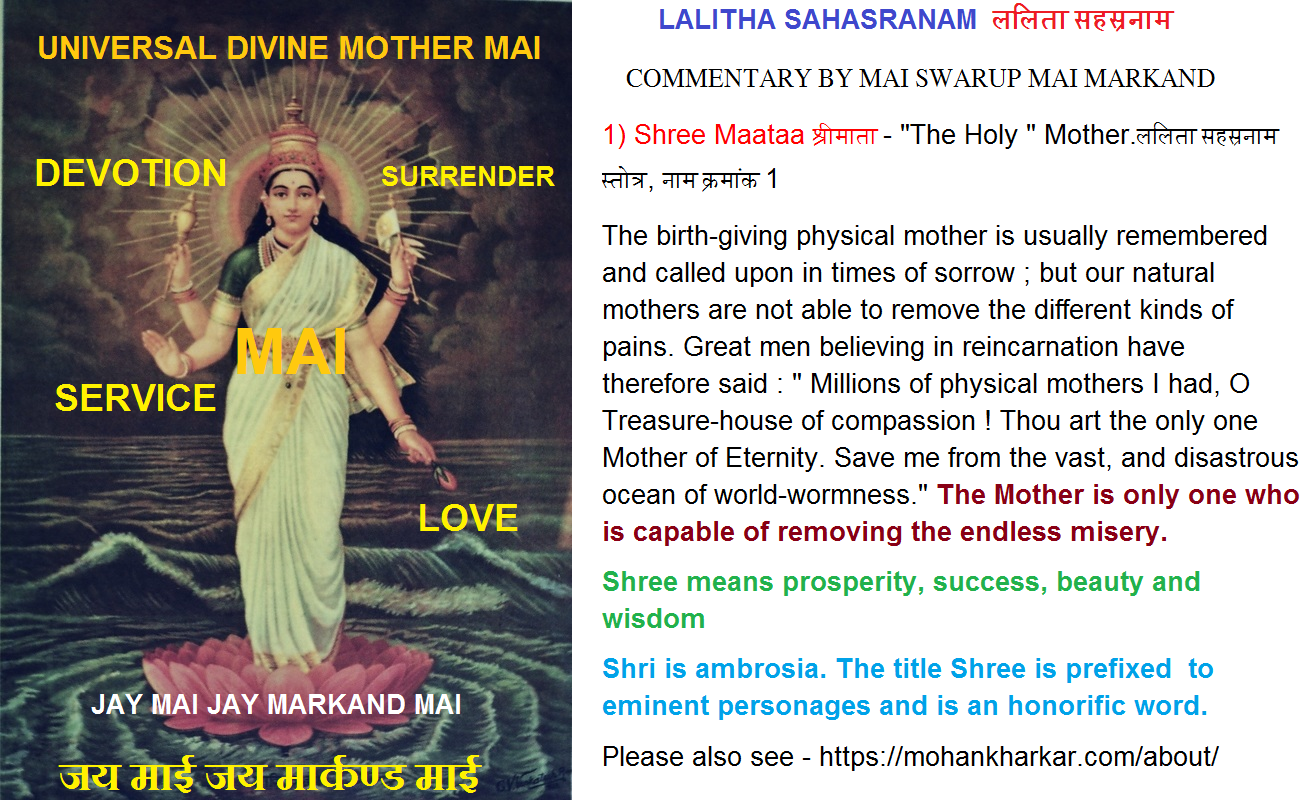
1) Shree Maataa श्रीमाता“The Holy ” Mother.ललिता सहस्रनाम स्तोत्र, नाम क्रमांक 1

The birth-giving physical mother is usually remembered and called upon in times of sorrow; but our natural mothers are not able to remove the different kinds of pains. Great men believing in reincarnation have therefore said: “Millions of physical mothers I had, O Treasure-house of compassion! Thou art the only one Mother of Eternity. Save me from the vast and disastrous ocean of world-wormness.” The Mother is only one who is capable of removing the endless misery.

Shree means prosperity, success, beauty and wisdom

Shri is ambrosia. The title Shree is prefixed to eminent personages and is an honorific word.

2) Shree Mahaaraajni श्रीमहाराज्ञी“The great” Queen. The controller of the created Universe. ललिता सहस्रनाम स्तोत्र, नाम क्रमांक 2

She by whose Grace the creation goes on. She who is the fighting Heroine Queen, and who fights out and dispels and controls all that is obstructive for Her devotees.

3) Shrimat Sinhaasaneshvari श्रीमत्सिंहासनेश्वरी“The Ruler” on the lion-throne.ललिता सहस्रनाम स्तोत्र, नाम क्रमांक 3

One rendering is Sinha सिंह meaning pain and asana असन  means expelling.

She is the destroyer of universe or that into whom the created beings enter on their dissolution. She is the Queen of Queens, Mother who is the most supreme merciful Donor, holds Her Darbar and grants whatever is demanded by Her devotees, and by all in good relations with them.

4) Chidagnikunda-Sambhootaa चिदग्निकुण्डसंभूताWho is born from the altar of the fire of consciousness. ललिता सहस्रनाम स्तोत्र, नाम क्रमांक 4

If Mother is such a heroic and Majestic Queen, is She also unapproachable like such queens? No, just the reverse, She is at your beck and call. From the fire of devotion of a devotee that burns within his heart uninterruptedly, without fuel, and dispels the darkness of desire and attachment to other things and other persons , She at times bursts forth. Devoted heart is a fire because it consumes the sins and evils of the Universe and Mother abides in that fire, though not born from it.

Mother has often appeared from the physical altar of religious sacrifices as well. Thus run some of descriptions – “Out of the sacrificial fire, slowly arose a woman divinely beautiful, adorned with divine ornaments and bright as the moon. She was Mother, the only one, the supporter of the Universe, equal to whom there is none “. Again we have ” Then the devotees constructed a very beautiful sacrificial altar and the devotees offered their body, mind and soul as oblations. When they were about to offer up the whole of their bodies, there appeared a great blaze of light, bright as millions of suns and cool as millions of moons put together; in midst of this light was seen an indescribable wheel-form ( Shree Chakra ); and from its centre the Great Mother shining like the morning sun dawned forth. On beholding the great Mother, the souls of all were filled with ecstasy and they bowed to Her again and again.”

5) Bhakta-Kaarya Samudyataa भक्तकार्यसमुद्यता“Manifested Herself ” for fulfilling the objects of the Devotees.ललिता सहस्रनामस्तोत्र, नाम क्रमांक 5

In the original it is “Devakaarya “referring to Devaas. The same word can be retained and be interpreted to mean that Mother is constantly engaged in transforming Her devotees to be the most shining deified beings. But as the Universal Mother has no partiality to gods and demons, I make the change least that same may be perpetuate the long carried misunderstanding. Her eternal occupation is fulfillment of devotees’ desires and their transformation.

6) Uddyat-Bhaanu-Sahasraabhaa उद्यतभानुसहस्राभाThis indicates She is very red. ललिता सहस्रनाम स्तोत्र, नाम क्रमांक 6

Rosy complexion is indicative of freshness, Love and mercy. There are three forms of Mother, the physical (sthula स्थुल ), the subtle (sukshma सुक्ष्म )  and the supreme (para पर ).The physical form has hands,feet, etc. and is elemental, the subtle consists of Mantra and ethereal, while the supreme is made of the Vaasanaas वासना and is ideal.

7) Chaturbaahu-samanvitaa चतुर्बाहुसमन्विता Endowed with four arms. ललिता सहस्रनाम स्तोत्र,नाम क्रमांक 7

8) Raagasvarupapaashaadhyaa  रागस्वरूपपाशाढ्याHolding the noose of desire.  ललिता सहस्रनाम स्तोत्र,नाम क्रमांक 8 

Desire is the Supreme, the third, i.e., the Vaasanaa form of Mother, the noose being the corresponding gross form. This weapon She has in Her lower left hand. The subtle form of noose is Hreem.

9) Krodhaakaaraankushojwalaa क्रोधाकारांकुशोज्ज्वलाShining with the elephant-hook of both “wrath and worldly knowledge “.  ललिता सहस्रनाम, नाम क्रमांक 9 

Aakaara आकार may be taken to mean self-created universe of souls based on ignorance, world-attachment and world-wormness.

She shines, holding in Her lower right hand, the elephant-hook which increases or removes world-wormness, wrathfulness, hatred, etc. The noose and the elephant-hook of Her are spoken as desire and anger. The noose is Ichchhaashakti, the goad, JnaanaShakti ज्ञानशक्ती , and the bow and arrows referred to next, represents Kriyaashakti क्रीयाशक्ती .

10) Manorupekshukodandaa मनोरूपेक्षुकोदण्डाArmed with the sugar-cane bow of mind.  ललिता सहस्रनाम स्तोत्र,नाम क्रमांक 10 

Mind characterised with both Sankalpa संकल्प and Vikalpa विकल्प  (healthy and unhealthy, rational and irrational thinkings)is the bow. This is in Her upper left hand. Mind has mainly four functions. {1} Covering the whole vision with thoughts of ” I, my, mine, not I, not my, not mine,” {2} Oscillating between several aspects of a question, {3} Discriminating and determining and {4} Unifying oneself with. These are, in one word, egoism, thinking, discriminating and being one with.

EXTRACT FROM : MOTHER AND MOTHER’S THOUSAND NAMES

AUTHOR : MAI SWARUP MAI MARKAND

MAI NIWAS, SARASWATI ROAD END, SANTACRUZ WEST MUMBAI 400054 INDIA

DAILY PRAYERS OF DIVINE MOTHER


The entire absence of joy or the continuous feeling of being miserable , for them they do not Thee or the imitative or delusive joy arising from the worldwormness and sense living of them that are in dark regarding Thee respectively. These two as also the joy of truely wise and followers of truth, all proceed from Thee and are making of Thine  and are aspects of Thine alone. 


                                                             DAILY PRAYER

If Love is Mother and Mother is Love, I am Mother’s and Mother is mine. Mother ! Bless the readers, Bless Thy followers. Bless Thy surrender seeking. Be Thou pleased with any one that repeats Thy sacred name. On Thyself being propitiated and pleased, let the little universe of every devotee of Thine be most pleased, satisfied, comfortable and happy.
Let it be Thy Grace, that the rulers lead the ruled into the righteous path.

Let good befall to the lot of all. Let the universe be happy with rains, crops, contentment and prosperity.
Make Thy devotees live in peace and bliss without fear. Make all beings to relish pleasure in attending to their duties, and on attaining their spiritual welfare.
Make the wicked virtuous, make the virtuous successful in attaining their peace of mind. Make tranquillised souls free from bondages. Inspire and help the freed, to be taking up as their life mission, the work of helping, loving and serving others , to free themselves through Thy Mercy and Guru’s Grace.
May all be freed from dangers. May all understand and attain good. May all be living nobly. May all be rejoicing in the universal spiritual good of all.
Mother! Make all happy, free from all worries and diseases and all calamities. Make each one and all of us, enabled to enjoy the Best, what is Divine, Sublime and Good.
JAY MAI JAY MARKAND MAI, JAY MARKAND RUP MAI, JAYA MARKAND RUP MARKAND MAI. ~ MAI-ISM BOOK NOTE 777

~ SAINT SHRI MAI SWARUP MAI MARKAND ( MAIJI )

MAI NIWAS, SARASWATI ROAD END, MUMBAI 400054 INDIA

FEW HYMNS AND PSALMS OF HINDU GODS AND GODDESSES : –

श्रीराधा-अष्टोत्तरशतनामस्तोत्रम् 

%e0%a4%b0%e0%a4%be%e0%a4%a7%e0%a4%bf%e0%a4%95%e0%a4%be

ध्यान
हेमाभां द्विभुजां वराभयकरां नीलांबरेणवृतां श्यामक्रोडविलासिनीं भगवतीं सिन्दुरपुंजोज्वलाम् ।
लोलाक्षीं नवयौवनां स्मितमुखीं बिंबाधरां राधिकां नित्यानंदमयीं विलासनिलयां दिव्यांगभुषां भजे ।।

स्तोत्र
अथास्या संप्रवक्ष्यामि नाम्नाष्टोत्तरं शतम् । यस्य संकीर्तनादेव श्रीकृष्णं वशयेद ध्रुवम्  । 1 ।

राधिका सुंदरी गोपी  कृष्णसंगमकारिणी । चंचलाक्षी कुरंगाक्षी गांधर्वी वृषभानुजा । 2 ।

वीणापाणिः स्मितमुखी रक्तशोकलतालया । गोवर्धनचरी गोपी गोपवेषमनोहरा । 3 ।

चंद्रावलीसपत्नी च दर्पणास्या कलावती । कृपावती सुप्रतिका तरूणी ह्रदयंगमा । 4 ।

कृष्णप्रिया कृष्णसखी विपरीतरतिप्रिया ।  प्रवीणा सुरतप्रिता चंद्रास्या चारूविग्रहा । 5 ।

केकराक्षी हरःकांता महालक्ष्मी सुकेलिनी । संकेतवटसंस्थाना कमनीया च कामिनी । 6 ।

             वृषभानुसुता  राधा किशोरी ललिता लता । विद्युतवल्ली कांचानभा कुमारी मुग्धवेशिनी । 7 ।

केशिनी केशवसखी नवनीतैकविक्रया । षोडशाब्दा कलातपुर्णा जारिणी जारसंगिनी । 8 ।

हर्षिणी वर्षिणी वीरा धीरा धारा धरा धृतिः । यौवनस्था वनस्था च मधुरा मधुराकृतिः । 9 ।

वृषभानुपुरावासा मानलीलाविशारदा । दानलीला दानदात्री दण्डहस्ता भ्रुवोन्नता । 10 ।

सुस्तनी मधुरास्या च बिंबोष्ठी पंचमस्वरा । संगीतकुशला सेव्या कृष्णवश्यत्वकारिणी । 11 ।

तारिणी हारिणी ह्रींला शीला लीला ललामिका । गोपाली दधिविक्रेत्री प्रौढा मुग्धा च मध्यगा । 12 ।

स्वाधीनपतिका चोक्ता ख्णडिता याभिसारिका ।रसिका रसिना रस्या रसशास्त्रैकशेवधिः ।13 ।

पालिका लालिका लज्जा लालसा ललनामणिः । बुरूपा सुरूपा च सुप्रसन्ना महामतिः । 14 ।

इति श्री राधका अष्टोत्तर शतनाम स्तोत्रं समाप्तम् ।

श्री महालक्ष्मीची आरती 

जय देवी जय देवी जय महालक्ष्मी ।
वससी व्यापकरुपे तु स्थुलसुक्ष्मी ।
करवीरपुरवासिनी सुरवर मुनि माता ।
पुरहरवरदायिनी मुरहरप्रियकांता ।
कमलाकारे जठरी जन्मवीला धाता ।
सहस्रवदनी भुधर पुरे न गुणगाथा ।
मातुलिंग गदा खेटक रवि किरणी ।
झळके हाटकवाटी पियुष रसपाणी ।
माणिक रसना सुरंग वसना मृगनयनी ।
शशिरवदना राजस मदनाची जननी ।
ताराशक्ती अगम्य शिवभजका गौरी ।
सांख्य म्हणती प्रकृती निर्गण निर्धारी ।
गायत्री निजबीज निगमागमसारी ।
प्रकटे पद्मावती निजधर्माचारी।
अमृतसरितेभरिते अघदुरिते वारी ।
मारी दुर्घट असुरा भवदुस्तर तारी ।
वारी मायापटल प्रणत परिवारी ।
हे रुप चिद्रुप तद्रुप दावी निर्धारी ।
चतुरासने कृत कर्माच्या ओळी ।
लिहील्या असतील माते माझ्या निजभाळी ।
पुसोनी चरणातळी पदसुमने क्षाळी ।
मुक्तेश्वर नागर क्षीरसागर बाळी ।
जय देवी जय देवी जय महालक्ष्मी ।
वससी व्यापकरुपे तु स्थुलसुक्ष्मी ।

श्री महालक्ष्मीचा पाठ
। श्री गणेशाय नमः। श्री सरस्वत्यै नमः। श्री गुरूभ्यो नमः। जय माई मार्कण्ड माई । श्री कुलदेवतायै नमः।
अविघ्नमस्तु
नमन तुला श्री गजानना । विघ्नहर्ता तु गजवदना । पुर्ण करूनी सर्व कामना । यश दे मला गौरीनंदना । 1 । शरण तुला श्री गणपती । कवनास देवा द्यावी मती । करितो श्रध्देने तव भक्ती । हे थेउरवासी चिंतामणी । 2 । जय जय श्री गौरीतनया । वक्रतुण्ड हे महाकाया । जय तुझा सिध्दीविनायका । पालक तु आमचा चिन्मया । 3 । रक्षी प्रभो मज लंबोदरा । शरण तुला मी विघ्नेश्वरा । प्रणिपात हे बल्लाळेश्वरा । दे यश धन मयुरेश्वरा । 4 । कृपा असावी गिरीजात्मका । गाती स्तवन विघ्नहारका । तारावे या तुझीया सेवका । नमन श्री वरदविनायका । 5। दे अभय, अभय वरदा । लोटांगणे माझी सहस्रदा । तव पावन पदा, भालचन्द्रा । प्रसन्नवदना यश दे सदा । 6 । अष्टभुजेचा पाठ हा रचिला । आशीर्वाद त्रिनेत्रा द्यावा मला । सौख्य द्यावे गणेशा सकला । वाहतो या शब्दमाला तुला । 7 । नमन तुला श्री सरस्वती । विद्यादेवी महा भगवती । सकल कलांची तु स्फुर्ती । वीणाधारी दिव्य वागीश्वरी । 8 । ऐका ऐका श्रोते जन । निर्मळ करा आपले मन । पूर्ण पावलो समाधान । ऐका दृष्टांताचे कवन । 9 । मग दृष्टांताची कथा सुन्दर । सांगतो आता मी सविस्तर । चित्त ठेउनी अति स्थीर । श्रोत्यांनो एेकावी निरंतर । 10 । अंबाबाई तुवा देउनी दृष्टान्त । मज रूप दाविले स्वप्नात । सेविले तुझ्या रूपाचे अमृत । ते वर्णी आता येथ । 11 । आज वर्षे दोन पुरी झाली । कथा ही खरी घडली । अष्टभुजा मज प्रसन्न झाली ।कृष्णा तीरी त्या राउळी । 12 । अश्विन शुध्द अष्टमीला । रात्री दृष्टांत हो हा घडला । सांगतो देवी भक्तांना सकळा । जो पाहिला मी सुखसोहळा । 13 । आपत्ती घोर आल्या मजवर । एकामागुनी एक भयंकर । क्रुर दैवगती करी प्रहार । मी विटलो संसारास अपार । 14 । गेली तीन मुले सुंदर ती । जन्मताच हो गोजिरवाणी । करूनी काळजाचे पाणी पाणी । मम कांतेचे तरूणपणी । 15 । स्मशान कळा आली घरास । जाती मुले येता जन्मास । एक जन्मला पुत्र करूनी नवस । जन्मांधच तो आला जन्मास । 16 । जडला रोग असाध्य कांतेस । पडली खिळून अंथरूणास । उत ये त्यातच दारिद्र्यास । विटलो मी संसारास । 17 । भ्रमिष्ट झाली माझी मती । दुःख्ख भोगी भार्या सती । कुणास सांगावी स्थिती । संसाराची झाली माती । 18 । चिडून जगावर निघालो भटकत । पायी यात्रा एकटा करीत । वेड्यासम चाललो नादात । तगमग मनीची शांतवीत । 19 । लागले कृष्णातीरी एक ग्राम । भवानीनगर त्याचे नाम । सृष्टी सौर्न्दयाचे जणु धाम । वाटला घ्यावा मनी विश्राम । 20 । पवित्र वाहे कृष्णा माउली । मांगल्य मूर्तिमंत त्या जली । भूमी ती सारी पावन झाली । पुण्य जले युगे युगे न्हाली । 21 । तीरी मंदिर विशाल एक । श्री अष्टभुजेचे सुरेख । नक्षी स्तंभास्तंभावर प्रत्येक । कोरिली चित्रे अंबेची कित्येक । 22 । बाग समोर आलेली बहरा । सोनचाफा निशीगंध मोगरा । दरवळे आसमन्त सारा । सुगंधाने भरलेला वारा । 23 । भव्य सभामंडप निवांत ।मंद दीप जळे एक शांत । गूढ भासे तो एकान्त । विसरलो क्षणभर मी खंत । 24 । अंबेचे ते जागृत स्थान । कृष्णा तीरी एक महान । लवते श्रध्देने ही मान । हरपते सार अन भान । 25 । राहिलो रात्री मी मंदिरी । अश्विन शुध्द अष्टमीला कृष्णा तीरी । दुःख्खाने पोळलो होतो अंतरी । श्रध्दने टेकला माथा अंबेच्या पदावरी । 26 । उच्च वेदीवरी अधिष्ठीत । उभी देवी गाभार्यात । ठसले ते रूप ह्रदयात । आले नीर अन् लोचनात । 27 । झळाळे मुकुट दिव्य । हिरवी साडी चोळी रूप भव्य गळ्यात सुवर्णहार असंख्य । पाषाणातुनी उमलले काव्य । 28 । करी कंकणे लखलखती । पायी जोडवी चमचमती । बाहुभूषणे झगझगती । मंगलरूप ते वर्णावे किती । 29 । सकल श्रृंगार देवीला । धूपाने धुंद गाभारा भरला । घमघमती ताज्या फुलामला । दीप मिणमिणता एकला । 30 । हाती गदा खड्ग बलशाली । मळवट भरलेला भाळी । उभी समोर अंबा माउली । परम भक्ताची साउली । 31 । घेतली रानफुले करात । प्रखर भक्ती पेटली ह्रदयात । गेलो समोर आवेगात । घातला साष्टांग प्रणिपात । 32 । धुतली आसवांनी पाउले । असीम श्रध्देने शीर टेकले । भान पुरते हरपुनी गेले । ह्रदयी कल्लोळ प्रेमाचे उसळले । 33 । अंबेचे ते पाहुनी रूप। सरलि नेत्राची उघडझाप । सरले सारे मनीचे व्याप । 34 । विसरलो दुःख्ख विसरलो सुख । विसरलो अमृत विसरलो वीख । केवळ दिसे अंबेचे रूप सुरेख । नाठवे गरदार काही एक । 35 । पुसले कळवळुनी अंबेला । संकटात का टाकले मला । माते काय गुन्हा घडला । दुःख्खाने का जाळतेस मला । 36 । माझ्यावरी का आणल्यास आपत्ती । हिरावूनी नेलीस संतती । आरोग्य शांती अन संपत्ती । 37 । कर मुक्तता माझी यातुनी । ना जाईन तोवरी येथुनी । आता चरण तुझे सोडुनी । माते सांगतो तुला निक्षुनी । 38 । भक्त तुझा पडता संकटी । दुःख्खे तु त्याची निवटी । त्यावरी करोनी कृपादृष्टी । धरितेस आपुल्या पोटी । 39 । असे म्हणुनी अष्टभुजा मातेस । मिठी मारली तिच्या चरणास । शरण अंबिकेचा मी दास । तळमळूनी केला अट्टाहास । 40 । राहिलो तसाच रात्रभरी । माथा टेकुनि त्या पायांवरी । श्रध्देने बेहोष मी अंतरी । भाव ठेविला अष्ट भुजेवरी । 41 । तदा अदभुत गोष्ट घडली । मध्यरात्रीच्या गुढ वेळी । अंतर्धान मूर्ति ती पावली । मूर्तीतुन प्रकटली अंबा माउली । 42 । मी थरथरलो रूप पाहुनी । लोटांगण घातले हात जोडुनी । वाहू लागले नीर लोचनातुनी । देखूनी ती भगवती योगिनी । 43 । हिरवे पातळ भरजरी । हिरवी चोळी त्यावरी । हिरव्या बांगड्या करी । मळवट अन भाळावरी । 44 । गळ्यात हार सुवर्णांचे । चमचमत्या असंख्य रत्नांचे । शरीर भासे तप्त कांचनाचे । देदीप्यमान रूप ते अंबेचे । 45 । हाती खड्ग चक्र गदा कमल । झळझळे रूप ते विमल । प्रभा फाकली सर्वत्र धवल । कोटी चन्द्रांचे उगवले मंडल । 46 । किती प्राशावे रूप ते मनोहर । डोळे हवेत सर्वांगावर । तरी आत्मा ना तृप्त होणार । समोर अंबा पहाता साकार । 47 । निःशब्द पडलो मी खाली । अचानक तो अमृतवाणी झाली । क्षणी तनु माझी रोमांचली । एेकुन अमर ती शब्दावली । 48 । भिउ नकोस माझ्या बाळा । रक्षिते मी तुजसम भक्ताला । श्रध्देने जो शरण आला । आशीर्वाद उठ लडिवाळा । 49 । माझ्या स्वरूपाची महती । वर्णावया तुझ देते शक्ती । श्रध्दा ठेउनी करावी भक्ती । होईल सकल सुखाची प्राप्ती । 50 । सांगते व्रत तुला एकपण । निष्ठेने कर त्याचे आचरण । सुखदायी होईल सारे जीवन । मनीच्या इच्छा सफल संपूर्ण । 51 । गहन रानात , नदी पल्याड । आहे औदुंबराचे एक झाड । सभोवती त्याच्या भव्य पहाड । भयाणता नांदते तेथे गाढ । 52 । त्या औदुंबरा खालती निवान्त । महातपस्वी एक महंत । दत्तात्रेयाचा अवतार मूर्तिमंत । करी तपश्चर्या वर्षे गेली सात । 53 । सेवा महन्ताची तू त्या कर । भयाण अरण्यी राहुनी खडतर । तो प्रसन्न होईल जेव्हा तुजवर । सांगेल माझ्या रूपाचे स्तवन सुंदर । 54 । बोलुनी अदभुत अशी वाणी । अदृश्य झाली जगदंबा झणी । नयनांत आनन्दे आले पाणी ।। प्रसन्न मजवर जगदंबा योगिनी । 55 । काळी गहन रात्र मृत होउन । जन्मली पहाट बाहेर नवीन । पूर्वा माता प्रसूत होउन । जन्मा आले सुर्य नारायण । 56 । क्षितिज वेलीला सुमंगल । आले विशाल सूर्यफूल । लागली पक्ष्यांस चाहुल । झाली सुरू गोड किलबील । 57 । विशाल क्षितीज वेलीवरी सारा । की गहरला उषेचा फुलोरा । उजळला कृष्णेचा किनारा । विरला एक एक तारा । 58 । माझ्या मनी आनन्द कोंदला । सुरूवात झाली नव जीवनाला । लोटांगणे घालुनी देवीला । निघालो महन्ताच्या सेवेला । 59 । प्रवाहात कृष्णेच्या पहाट वेळी । खुशाल उडी मी झोकली । ध्यानी मनी अंबा माउली । तारणारी तीच संकट काळी । 60। पार करूनी क्षणात । आलो मी गहन रानात । अंधार रानी दिवसाही आत । जाती सर्प काळे समोर फुत्कारित ।61 । धडधडे भीतीने अंतःकरण । निघालो करीत अंबेचे स्मरण । तीच करणारी सर्वांचे रक्षण । वंदितो जगदंबे तुझे चरण । 62 । तो दिसले औदुंबराचे झाड समोर । बसलेला त्याखाली महंत धोर । केला भक्तीने त्यास नमस्कार । सांगितला घडलेला प्रकार । 63 । अभय दिले महंताने मला । श्रध्देने लागलो मी सेवेला । कंदमुळे होती खाण्याला । जमीन अन झोपण्याला । 64 । पहाटे आणावे मी पाणी । काढावा आश्रम झाडूनी । सांगीतलेले काम करूनी । वाहिलो महंताच्या सेवेत । 65 । निष्ठा राखुनी राहिलो मी रानी । खंगले शरीर उपवासानी । प्रसन्न झाला महंत एकेदिनी । म्हणाला आशीर्वाद देउनी । 66 । सांगतो अष्टभुजेचे स्तवन । स्वरूपाच्या तिच्या मंगलगान । कर अता त्याचे श्रवण । अति निर्मळ ठेउनी मन । 67 । जो करील देवीचे स्तवन । गाढ श्रध्देने अनुदिन । दुःख्ख जाईल त्याचे निघुन । संकटाचे होईल दहन । 68 । होईल पुत्र त्यास,जो निःसंतान । मिळेल विपुल यश धन । गाजेल त्याची कीर्ती महान । होतील कामना सफल संपूर्ण । 69 । असे म्हणूनी महन्त तो महान । करी सुरू अष्टभुजेचे स्तवन । केले सर्वांगाचे मी कान । श्रवण करण्यास ते कवन । 70 । जय जय अष्टभुजे सबले । जगन्माते महामंगले । तु विश्व सारे निर्मीले । वंदितो तुझी चरण कमले । 71 । जय जय श्री भवानी माते । तुळजापूरच्या महादेवते । अभय दे वर दे शक्ती दाते । शरण शरण आम्ही तुला माते । 72 । जय देवी जय श्री जोगेश्वरी । निवास तुझा गे पुण्यपुरी । सुखशांती दे या संसारी । कर मनीची कामना पुरी । 73 । जय अंबे करवीरवासिनी । विश्वतारिणी पाप हारिणी । सकल कला कामिनी । चण्डमुण्ड विनाशिनी । 74 । जय जय देवी एकवीरे । प्रणाम करितो आदरे । विश्व उभे तुझ्या आधारे । तु निर्मिलेस सुर्यतारे । 75 । जय सप्तश्रृंगी माउली । भक्तांची तु गे साउली । तु जयंती भद्रकाली । माथा ठेवितो तुझ्या चरणाखाली । 76 । जय जय ग्रामवासी पद्मावती । भक्तीने करितो आरती । कर सकल कामना पूर्ति । ह्रदयात वसे तुझीच मूर्ती । 77 । जय जय महषासुर मर्दिनी । यश दे वरदायिनी । देवी पाप विनाशिनी । सकल खल निर्दालिनी । 78 । जय जय चण्डिके भैरवी । तेज झळाळे जणु कोटी रवी । किती वर्णावी तुझी थोरवी । कृपा भक्तावरी असावी । 79 । जय जय देवी दुर्गा । नष्ट कर शत्रुच्या गर्वा । सौख्य दे जगती सर्वा । लखलखते तुझ्यामुळे पुर्वा । 80 । रूप दे जय दे भगवती । कर नष्ट शत्रु जगती । यश दे देवी तु महाशक्ती । नमन तुला महामती । 81 । सुख दे सौभाग्य शांती दे योगिनी । पुत्र दे धन दे वरदायिनी । कीर्ती दे विद्या दे जननी । आरोग्य दे तपस्विनी । 82 । तु शैलपुत्री ब्रह्मचारिणी । तु स्कंदमाता कात्यायिनी । दुर्गा महिषासुरमर्दिनी । शुंभ निशुंभ विनाशिनी । 83 । तु चंद्रघंटा कुष्माण्डा । व्यापिलेस सकल ब्रहृ्मांण्डा । तुझा गावा महिमा केवढा । मी शरण तुला बापुडा । 84 । तु महागौरी सिध्दीदात्री । भव्य भैरवी कालरात्री । तु निर्मीली धरित्री । प्राण ओतीलास या गात्री । 85 । तेजाने तुझ्या गे उज्ज्वल । उमलले हे विश्व कमल । वाहुनी मम मन कमकल । पूजितो तव पद विमल । 86 । तु जयंती भद्रकाली स्वाहा । कपालिनी मंगला क्षमा महा । दीन भक्त शरण तुला हा । रक्षी आम्हा देवते महा । 87 । नमन तुला विश्वस्वामिनी । हे मधुकैटभनाशिनी । अभय दे कल्याण दायिनी । सुखशांती दे वरदायिनी । 88 । तेज तुझे झळाळे देवी । कोटी कोटी जणु रवी । तव इच्छेने चाले पृथ्वी । भद्राकली हे भैरवी । 89 । तु सकल विश्वाची स्वामिनी । जगत निर्माती जननी । संहार करिशी तु प्रलयिनी । महामंगला सर्वव्यापिनी । 90 । तु स्वाहा तु स्वधा अमृतरूपी । तु वषटकार प्रणवातील मात्रा तिन्ही । सकळ स्वरांचे मुळ तत्वरूपी । विश्वाचे आदितत्व तवरूपी । 91 । तु महामाया महाविद्या आई । महाबुध्दी महास्मृती देवी । महा मोहा महेश्वरी महादेवी । अंबे रूपे तुझी नवी नवी । 92 । नमन तुला महाकाली सती । तु महालक्ष्मी सरस्वती । तव भक्तीने संकटे नासती । शरण शरण तुझ्या प्रती । 93 । सेवा तुझी घडो सुरेश्वरी । भक्ताकडुनी जन्मभरी । कर दया तुझिया सेवकावरी । हे महामंगले भुवनेश्वरी । 94 । तु खड्ग शुल कमल धारिणी । शुंभ निशुंभास मारलेस रणी । मुक्त केलीस दैत्यापासुनी धरणी । अभय मिळते तुझ्या चिंतनी । 95 । जगदंबे तु वेदांचा आधार । विष्णुला ना लागला तुझा पार । सकल शास्त्रांचे तु सार । कर भव सागारतुनी नौका पार । 96 । गाती सकल देव तव कीर्ती । दैवी तेजाने घडविली तुझी मूर्ती । सकल विश्वाची तु स्फूर्ती । कर भक्ताची कामना पूर्ती । 97 । लक्ष्मी तु वससी विष्णु ह्रदयी । गौरी तु शंकराची महायोगी । कांती तुझी दिव्य कांचनमयी । कर सर्व कार्यास यशदायी । 98 । रूप दे जय दे योगेश्वरी । सुख सौभाग्य शांती दे जोगेश्वरी । आरोग्य धन दे परमेश्वरी । पुत्रपौत्र दे भुवनेश्वरी । 99 । तु सुंदर सत्य सनातन । तव चैतन्याने भरले जीवन । भक्तीने दाटले मम मन । नमन नमन वाहतो सुमन। 100 ।अंबे तु सुख सौभाग्यदायिनी । तु सकल कला कामिनी । योगिनी महाविलासिनी । नमन नमन तुला जननी । 101 । असे आहे अष्टभुजेचे हे स्तवन । कर श्रध्देने याचे तु पठण । मुक्त होशील सर्व दुःख्खातुन । म्हणे तो महंत महान । 102 । घेउनी आशिर्वाद तदा महन्ताचा । परतलो स्वगृही तसाच रात्रीचा । वरदहस्त मजवर जगदंबेचा । आनन्द वर्णू किती ह्रदयीचा । 103 । पाठ केला श्रध्देने शुक्रवारी । दिवसा राहिलो निराहारी । उपवास संध्याकाळी सोडला तदनंतरी । भाव ठेविला अंबेवरी । 104 । आचरिले व्रत असे स्तवनाचे । तो गेले असाध्य दुखणे कांतेचे । आश्चर्य अंधत्व सरले पुत्राचे । चमत्कार सारे हे जगदंबेचे । 105 । बोल सांगतो हे प्रचितीचे । स्तवन करा अष्टभुजेचे । वितळतील पर्वत संकटांचे । आटतील सागर दुःख्खांचे । 106 । अगाध मायेची हो करणी । सामर्थ्य आहे स्तवनी । वेल बहरेल अहो पाषाणी । प्रसन्न होता दुर्गा भवानी । 107 । जय जगदंबे माझे आई । कृपा करी हो अंबाबाई । चित्त लागु दे तुझे पायी । मी स्तवन तुझे गाई । 108 । श्रध्दा ठेउनी अंतरी । पठण जो पाठाचे करी । स्वप्नी येउनी जोगेश्वरी । करील कामना सफल पुरी । 109 । होईल पुत्र ज्यास नसे संतान । जगतील मुले जी जाती जन्मून । बरे होतील रोग कठीण । असाध्य जे महा भयाण । 110 । जो करील पाठ हा श्रवण । दारिद्य्र त्याचे जाउन दारूण । मिळेल त्यास अपार धन । होईल जगी त्याचा मान । 111 । यश मिळेल अपूर्व विद्येत । आनन्द नांदेल सदा घरात । बुध्दी वाढेल सकल ज्ञानात । श्रध्दा ज्याची अंतरात । 112 । सुख सौभाग्य शांती लाभेल सदा । दूर पळतील आपदा । मिळेल अचानक अशा धन संपदा । जगदंबा आहे अभय वरदा । 113 । या पाठाचे जो करील पुजन । आणीक करील श्रवण पठण । त्यास गावेल सुखाची खाण । अंबेचे ठेवावे सदा स्मरण । 114 । करोनी जगदंबेस नमस्कार । श्रध्देने करावा शुक्रवार । पाठ म्हणावा तदनंतर । अति शुध्द ठेउनी अंतर । 115 । भावे भजा अंबा चरण । आणि करा पाठ श्रवण । नउ मास भरता पुर्ण । अंबा स्वप्नी तोईल अवतीर्ण । 116 । भुकेल्यास द्यावे अन्न । तेणे होय जगदंबा प्रसन्न । आत्म्याला होईल समाधान । मिळेल विपुल यश धन । 117 । जैसी जैसी कराल भक्ती । तैसी वाढेल यशकीर्ती । फल पडेल पदरी निश्चीती । संशय आणू नये चित्ती । 118 । नमन तुला जगदंबा आई । ह्रदयात तु सदा वसावी ।तव कीर्ती मी गावी । कृपा माते माझ्यावरी असावी । 119 । जगदंबेची कृपा होता । स्वर्ग लाभे आपुले हाता । इतरांची मग काय कथा । लववितो अंबे चरणी माथा । 120 । कथिला हा माझा अनुभव । भक्तास संकटी तारितो देव । गाढ असु द्यावा भाव । मुखी अन जगदंबेचे नाव । 121 ।
। भगवती ॐ श्री अष्टभुजा जगदम्बा माउली चरणार्पणमस्तु ।
1968 साली छापलेल्या एका पोथी मध्ये हा अष्टभुजा महालक्ष्मीचा पाठ मला मिळाला व त्याची मला तत्काल प्रचिती मिळाली म्हणुन देवी भक्तांसाठी तो पाठ मी येथे दिला आहे. त्याची साधना करून लाभ घ्यावा ही देवीभक्तांकडुन अपेक्षा !! खाली कॉमेंट बॉक्समध्ये आपले विचार जरूर कळवावेत हि विनंती !!! धन्यवाद .